Showing posts with label books. Show all posts

Friday, November 13, 2015

Homeschool Wrap-Up With Master Schedule


Homeschooling is a blessing. Nary a day goes by that I don't feel that to my core. But it's very busy now that I have four school-age students. Here's an overview of our first-semester readings, followed by a master schedule we follow. Mental illness (severe OCD) is a big part of our day too and the schedule reflects that. We stick to the basics and they extend their learning outside in their own time. They're natural explorers/nature observers and they enjoy PE games together, too.

An overview of recent and current readings:

Boys - Literature: Treasure Island, and now The Wide Wide World (Christian classic fiction, written in 1850; very long...600 pages). Next up for the boys is Uncle Tom's Cabin.

Boys - History: Continuing with Story of the World, which they weekly tell me how much they love. I do believe they will revisit these four volumes on their own through the years. They find them incredibly engaging and interesting. Some topics are explored further either online or from a comprehensive, youth and Christian-friendly history of the world volume produced in conjunction with Beautiful Feet books.
Girls - We've gone through several selections on extended history of the Pilgrims (Beautiful Feet Early American History, primary), a Jamestown reading, The Courage of Sarah Noble, The Matchlock Gun, and library picture books with various social studies and science themes (see this post for more on the girls' reading--especially the library selections)

A few things are reserved in the evenings after Daddy returns at seven, after which we eat dinner and congregate in the living room for family prayer and an elective, such as great composer study, or drawing with a read-aloud.

Master Schedule
Morning Chores:

~ Get dressed; make bed
~ Clothes in hamper
~ Fold clean clothes, put away

Morning Subjects:

1. Bible Whole Family – Audio Bible on Bible Gateway (Using a Through-the-Bible-in-2-Years Schedule, chronological, Old Testament and New Testaments together; Boys/Mom follow in their own Bibles; girls color in Bible coloring books while listening)
Girls Narrate Bible Readings - Tues./Thurs.
Boys Narrate Bible Readings -  Mon./Wed./Fri.

2. Peter – Math
Paul – Literature & Narration (Oral narration – Tues/Thurs.; Written Narration Wed/Fri)
Girls – Journal Writing
Mom - Start bread making

Mid-Morning Subjects:

1. Peter – Literature & Narration (Oral narration – Wed/Fri;  Written narration Tues./Thurs.
Paul – Math
Girls – Beautiful Feet History Readings with Mom; take turns narrating. Narration is an important part of both Beautiful Feet History and Apologia Science. 

Some notes about narration: Narration (oral retelling for primary, turning to written narration for upper graders) was a natural, expected part of education in former centuries, especially for the upper classes. It got lost as homeschool and/or tiny one-room school houses morphed into modern public education. If you read books like Elsie Dinsmore or The Wide Wide World, you see how prominently narration and recitation figured into formal education. 

Visual learners don't learn as well through oral narration, and I take that into account in my homeschool, even if Charlotte Mason would disagree. The more the child groans about narration-- especially later in the year after they've had practice--the more you can take that whining as an indicator of learning-style preference. At first narration is hard for most of us, but auditory learners catch on more quickly. 

My Mary, age 8, can narrate like nobody's business; she amazes us all. Paul finds it akin to torture, but he's getting better and I don't push. His tendency is to try to include too much.

Mid-Morning Subjects Cont.:

2. Peter – Writing/Grammar
Paul – Apologia Science & Notebook
Girls – Free time

After-Lunch Subjects:

1. Peter – Apologia Science & Notebook
Paul – Writing/Grammar
BethAll About Reading Level 2 with Mom
Mary – Saxon 2 Math Practice w/ Paul nearby (Mary will start Teaching Textbooks Math 3 in December or January)

2. Peter – History Reading
Paul – History Reading
MaryAll About Reading Level 3 with Mom
Beth – Saxon 1 Math Practice

3. Peter – Apologia Science W/Primary Notebook Reading to Girls; Girls narrate; sometimes hands-on work
Paul – Computer Programming
Mom – Prepare Hands-on Saxon Math lesson for girls (combining the girls)

4. Boys – Online Geography on Kindle (to start Northstar Geography in Feb)
Girls – Saxon Hands-on Math Lesson with Mom

AWANA - I record their individual verses on my LG flip phone, which has better sound quality than our Kindle, and during the day they take turns listening to their verses with headphones. After about three days of this, they can usually recite the verses well with the reference. Paul prefers studying on his own, as oral work isn't as beneficial for him.

How has your semester been going? What readings have you enjoyed? 

Have a blessed weekend and thank you for reading here!


Weekly Wrap-Up

Wednesday, November 11, 2015

Educational Picture Books 2015 (and Thanksgiving books)

Here are some great educational selections for the whole family to enjoy together. Happy Reading!

by Brenda Z. Guiberson
 published June, 2015


Synopsis: Which sea creature is the greatest? Is it the one with the most venom, the greatest diver, the one with blue blood, or the best rotating eyes? Or is it the master of disguise, the one with the best light, the most slime, or the most eggs? Fascinating facts and spectacular illustrations will inspire young readers to choose their own favorite sea creatures!

Lives of the Explorers: Discoveries, Disasters (and What the Neighbors Thought)

by Kathleen Drull and Kathryn Hewitt
Published August, 2015


SynopsisYou might know that Columbus discovered America, Lewis and Clark headed west with Sacajawea, and Sally Ride blasted into space. But what do you really know about these bold explorers? What were they like as kids? What pets or bad habits did they have? And what drove their passion to explore unknown parts of the world? With juicy tidbits about everything from favorite foods to first loves, Lives of the Explorers reveals these fascinating adventurers as both world-changers and real people.
The entertaining style and solid research of the Lives of . . . series of biographies have made it a favorite with families and educators for twenty years. This new volume takes readers through the centuries and across the globe, profiling the men and women whose curiosity and courage have led them to discover our world.

by Nikki Bruno Clapper
Published October, 2015


Synopsis: What is a primary source? How does it compare to other types of sources? Even the youngest learners need to know the difference. Straightforward text and clear photographs give readers the tools they need to learn about primary sources and media literacy.

by Patricia Polacco
Published September, 2015


Synopsis: Friendship, loyalty, and kindness stand the test of time in this heartwarming World War II–era picture book based on a true story from the beloved author-illustrator of Pink and Say and The Keeping Quilt.

Tucky Jo was known as the “kid from Kentucky” when he enlisted in the army at age fifteen. Being the youngest recruit in the Pacific during World War II was tough. But he finds a friend in a little girl who helps him soothe his bug bites, and he gets to know her family and gives them some of his rations. Although the little girl doesn’t speak English, Tucky Jo and Little Heart share the language of kindness. Many years later, Tucky Jo and Little Heart meet again, and an act of kindness is returned when it’s needed the most in this touching picture book based on a true story.

My Notes: Loved this. Incredible true story and a tear-jerker, as so many of Patricia Polacco's books are. It realistically depicts the horrors of war, however it was not too much for my 6 or 9 year olds. I highly recommend it.

by Catherine O'Neill Grace and Margaret M. Bruchac With Plimoth Plantation
Published 2001


Synopsis: Countering the prevailing, traditional story of the first Thanksgiving, with its black-hatted, silver-buckled Pilgrims; blanket-clad, be-feathered Indians; cranberry sauce; pumpkin pie; and turkey, this lushly illustrated photo-essay presents a more measured, balanced, and historically accurate version of the three-day harvest celebration in 1621.

My notes: As part of my girls' Beautiful Feet History this year, we read a number of more accurate accounts of the first thanksgiving and the events leading up to it. This featured book also presents an accurate account, drawing from the primary sources we have available.

by Kathleen Krull
Published June, 2015


Synopsis: Many awe-inspiring women have changed the course of history. From fighting for social justice and women's rights to discovering and shaping our amazing country, women have left an indelible mark on our past, present, and future. But it's not easy to affect change, and these women didn't always play by the rules to make a difference! Kathleen Krull blends history and humor in this accessible young biography series.

Sacajawea was only sixteen when she made one of the most remarkable journeys in American history. She traveled over four thousand miles by foot, canoe, and horse-all while carrying a baby on her back! Without her, the Lewis and Clark expedition might have failed. Two hundred years later, we still can see how her unique journey demonstrated the strength and value of women.

by Kate Waters
Published 2001 


Synopsis: Sometime between September 21 and November 9, 1621, the Pilgrims and the Wampanoag people shared a harvest celebration that has become known as the First Thanksgiving. This is the story of what happened during those days, as told by dancing Moccasins, a fourteen-year-old Wampanoag boy, and Resolved White, a six-year-old English boy. Photographed in full color at the Plimoth Plantation, this accurate reenactment will let you experience a time when early English colonists settled on the rich and fertile land of the Wampanoag people.


By Marcia Sewall


Synopsis:  In a text that mirrors their language and thoughts, Marcia Sewall has masterfully recreated the coming of the pilgrims to the New World, and the daily flow of their days during the first years in the colony they called Plimoth.

Aye, Governor Bradford calls us pilgrims. We are English and England was our home...But our lives were ruled by King James, and for many years it seemed as though our very hearts were in prison in England...
September, 1620, our lives changed. We were seventy menfolk and womenfolk, thirty-two good children, a handful of cocks and hens, and two dogs, gathered together on a dock in Plymouth, England, ready to set sail for America in a small ship called the Mayflower...


After an abundance of prayers and tears we made farewells at dockside and boarded our small ship. Our voyage across the Atlantic Ocean "began with a prosperous wind," but the sea soon became "sharp and violent" and storms howled about us.

When the pilgrims set out for America, they brought with them a dream for the future. Sickness, hardship, and heartache stood in the way of that dream. But the pilgrims worked hard, keeping their dream close to their hearts, until they were finally able to make it come true.


A Turkey for Thanksgiving
by Eve Bunting


Synopsis: Mr. and Mrs. Moose invite all their animal friends for Thanksgiving dinner and the only one missing is Turkey. When they set out to find him, Turkey is quaking with fear because he doesn't realize that his hosts want him at their table, not on it.

My notes: One of my all-time favorite picture books. So cute! I love Eve Bunting.

by Margaret Pumphrey

Synopsis: This 1910 publication has been newly edited and expanded to include a horizontal history of the world of the Pilgrims of the early 17th century. This replaces the formerly titled Stories of the Pilgrims used in our Early American History Primary Study Guide. Now children will learn not only the faithful saga of the Separatist's struggle for religious freedom, but also that young Rembrandt was just learning to walk when the Pilgrims arrived in Leiden, that Galileo was fighting his own battle for religious and scientific freedom, and that William Brewster served as clerk to Queen Elizabeth's secretary until the ill-fated execution of Elizabeth's half sister, Mary. Historical figures from around the world will see the Pilgrim's heroic struggle in a more meaningful context. With whimsical illustrations by Christen Blechschmid, children and parents alike will see the world as the Pilgrims saw and lived it.

My Notes: Available from Beautiful Feet books, this is the most comprehensive history of the Pilgrims I've ever encountered. An excellent choice! I'm so glad we read it.

by Clyde R. Bulla


Synopsis: This biography for young readers tells of the adventurous life of the Wampanoag Indian who befriended the Pilgrims at Plymouth.

The selflessness of Squanto is a good starting point for a discussion about this pivotal time in American history, during which the Indians had to make room for the new, white culture. The story is simply, yet engagingly told, and will inspire many questions about the customs and lifestyles of two very different societies.


Eyewitness Tree: Discover the Fascinating World of Trees--From Tiny Seed to Mighty Forest Giants
by David Burnie
Published September, 2015


Synopsis: In this updated and revised edition of Tree, readers can follow a seed grow into a sapling, the changing colors of fall leaves, and the tiny insects that live in rotting leaves on the forest floor, plus learn why deciduous trees lose their leaves in the fall, how a tree breathes, how bark defends trees from attack by animals, and more.

Each revised Eyewitness book retains the stunning artwork and photography from the groundbreaking original series, but the text has been reduced and reworked to speak more clearly to younger readers. Still on every colorful page: Vibrant annotated photographs and the integrated text-and-pictures approach that makes Eyewitness a perennial favorite of parents, teachers, and school-age kids.

by Jessica Loy
Published April, 2015


Synopsis: There are lots of fascinating animals throughout the world with unusual characteristics. But you may be surprised to learn that many common animals may also have some uncommon characteristics For example, did you know that:

A giraffe can clean its own ears with its tongue?

Or that a hippo has teeth as long as a child's arm?

So come read facts about fourteen special animals who are less "normal" than we may think at first look.

by Chris Butterworth
Published August, 2015


Synopsis: Did you know that the cotton for your jeans was picked from a bush? How did the colorful wool in your sweater get from a sheep’s back to a ball of yarn? Where did your soccer uniform, your rain boots, and your fleece jacket come from? And what does recycling plastic bottles have to do with anything? Visit farms, forests, and factories all over the world to find out how everything you wear has a story behind it. Back matter includes an author’s note, an illustrator’s note, a bibliography, and an index.

Friday, October 16, 2015

Weekly Homeschool and Life Wrap-Up - October


Homeschool Philosophical Musings

We've hit a stage in our homeschool in which all four children are receiving a lot of formal education--the youngest having hit first grade. It's much more challenging to fit everything in for each child, and my perspective as to what constitutes "school" continues to mature. 

It's very tempting to view homeschooling as schooling at home, but it's much more than that. It isn't about defined grade-level expectations or taking government the same year as your public-schooled peers. As a homeschooling mother, it's about tailoring a garment to fit each child as well as possible considering their individual growth and stature--the garment being the education. 

Sometimes your 11 year old does better than your 13 year old in math, even as your 13 year old comes into his own as a courageous, discerning sibling leader. When you perceive homeschooling as a one-piece life in which learning is part of everyday existence, not a separate entity, then your definitions shift. 

The home front is the most important classroom and the schooling is learning how to live for the glory of God. Sometimes that includes 5 days of formal math lessons, while at other times it includes laboring in love for someone at church, or reading aloud long because everyone is frazzled and needs to recenter their hearts via Christ-rich content. Sometimes it includes learning how to keep clutter from taking over, and still other times includes brainstorming how to shave $100 a month off the already-shaved grocery budget. 

And very often for one-income families, it includes lessons in how to live with far less than those around you, while still feeling that the term abundant life fits your existence--because it should if you're in Christ. In our "homeschool" the lessons are deep and wide and the love even more so because it has to be. The challenges are just right and grace abounds because God is good. 

This is the Holy Spirit's shaping and as a mother I must help my children identify and be thankful for that shaping, rather than wondering where God's blessings went or why prayer isn't being answered this month. I want them to have lovely souls and that means bitterness and envy cannot take root. Shielding our hearts from ugliness means living a life of gratitude. It means understanding how the Potter shapes the clay and how the clay loves the Potter's work--even when the molding hurts.

Life is not about accomplishment and trappings, no matter what the world screams at us. It's about responding to each day and each trial with mercy and grace. It's about growing in grace rather than growing in goodness (growing in grace being something Ann Voskamp once said, but I don't remember where.)

And all that, my friends, is why schooling is part of a one-piece, big-picture life. That compass is how I measure my days, and I'm continually learning to navigate with it better and better, even as I inch closer to a substantially-wrinkled 50 years old. 

Why must wisdom come with wrinkles...and maybe that's why they both begin with w

The Week in Pictures:


My little Beth is such a delight! She's always creating something. Here's a doll bed made from an oatmeal container for her Rapunzel toddler doll--a doll acquired from a thrift store last week. Some days Rapunzel is reading Jane Eyre, and other days library picture books. "She's only three, Mommy, but she can read now." This, Beth tells me, after she "read" to Rapunzel herself for days.

Having a creative child means a messy house; I had to learn to define my housekeeping skills in broader terms than tidiness, having come to terms with my choices: I can break her spirit by insisting on tidiness, or I can come alongside her to clean up time and again, keeping our relationship sweet and satisfying.


We went to our favorite apple and pumpkin farm.


A hayride to the orchards on a 1950's tractor.


My Mary loving the lambs.


Beth and I, and me marveling that a precious one still fits in my lap!


About the tenth photo Daddy took, as you can tell by the so-not-enthused expression.


Always a doll or a stuffy with her. They need outings too, you know.


15 pounds of apples, which we've been happily feasting on--including one batch of applesauce, an apple crumb pie because I'm lazy about crusts, and one double-batch apple crisp.


This kind man, with a baby in one arm, was happy to introduce his springer spaniel to my smitten girls. It didn't work out with our stray dog last month, by the way.


Daddy with our boys. I believe Peter is 5'5'' now--gaining on Daddy's 5'8' and past my 5'3''. Doc says he'll be six feet.


Peter and Paul are well loved by their sisters. His OCD, though it drives us all crazy, doesn't impact their admiration and love. It may even increase it, in fact.


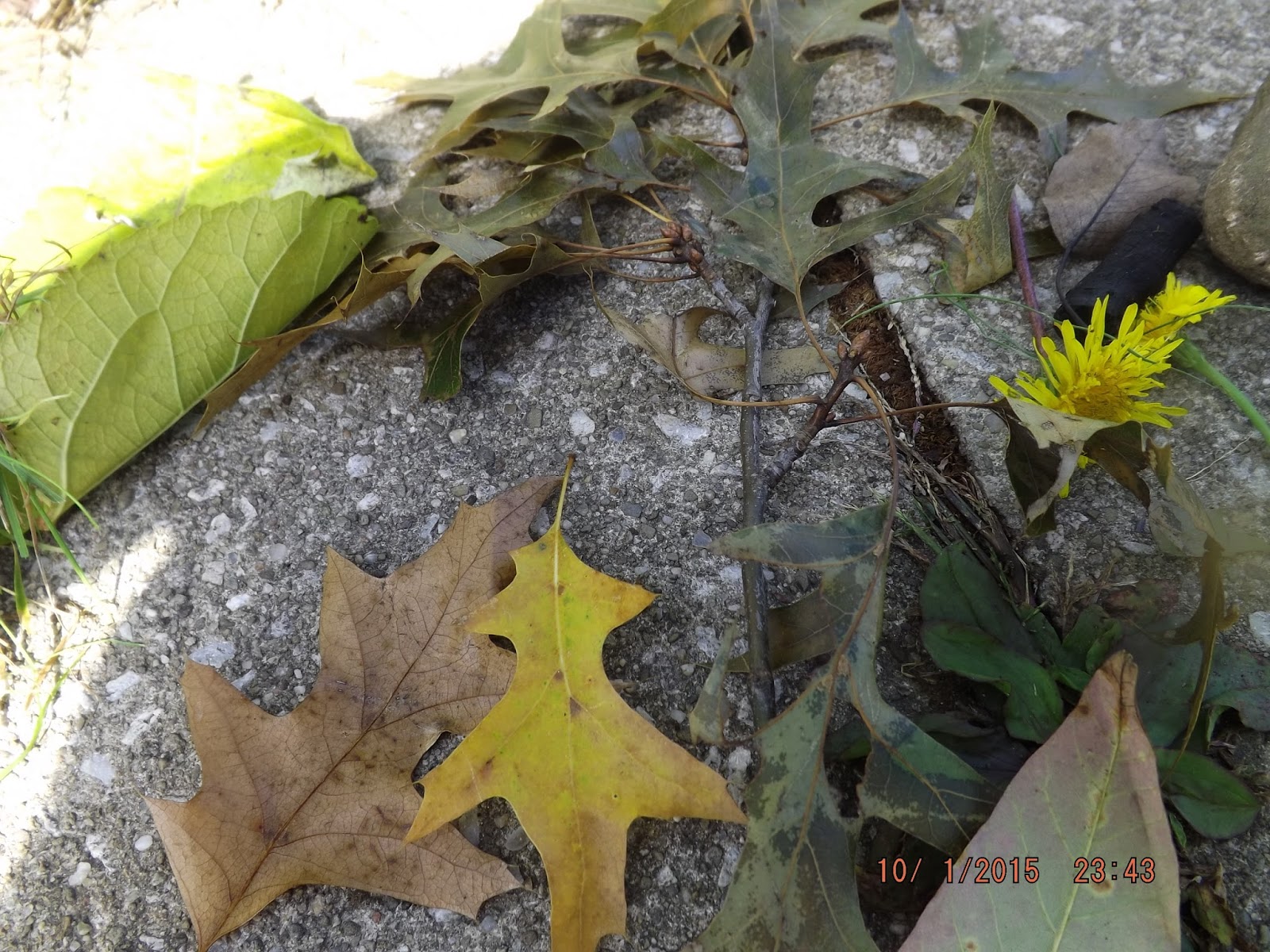
Two weeks ago Beth searched our property for fall nature samples. We have a lot more yellow, red, and orange this week.


Fall means Kent State University football games. They don't care for pro football, but college football rules their fall fun (or at least Paul's). They even play it out back with their sisters, which is a hoot. My husband is frequently gifted with tickets from various people at one of his workplaces, which makes up for the fact that we don't have cable to watch games. They see a few online via ESPN3, however.


I'm using recordings more and more in my homeschool. Here Beth is drawing from a library book while listening to Psalm 23 on my cell phone with headphones (recorded by my voice). She memorized it for AWANA this week and each time she recited it I choked up. Few things are sweeter than a six year old reciting Psalm 23.

Life News:
One of our Compassion International correspondent children left the program due to her family becoming more independent. They felt they could take care of her by themselves, leaving room for another needy child. She's been a delight to correspond with this past year, as our newest child, eight years old from Nicaragua.

That night, after Compassion called me about Abdi, they put a new correspondent child on my account: Brayan, a 13-year-old boy from the Dominican Republic; he lives with his mother and sadly, his father is deceased. I went into my account to write the October letters to our children and there he was... a precious new heart to share with. They told me they'd put me on a waiting list, so that was fast!

A correspondent child is not a sponsor child. Someone else, often a big company, will sponsor children but not commit to writing--writing being something that, along with helping in Jesus' name, is the cornerstone of Compassion International's program. They immediately assign a correspondent for these children.

We became correspondents in 2011, before we could afford to sponsor for $38 a month. After that we were so hooked on the experience, we sponsored a child without waiting for the budget numbers to work out. We've never missed a payment. Then we acquired another correspondent child, and then leaped ahead with another sponsor child. The last two have been correspondents, and that is the end of our faith walk for now. We can't squeeze another inch from this budget, though my heart longs to come up with more and more increments of $38, because these children are precious to their core and their letters are like gold. Outside of marrying and giving birth to my own loved ones, these children are the highlights of my life.

Call Compassion at 800-336-7676 to be a correspondent to a third-world child, which is a fantastic heart and learning endeavor for the whole family. Your children will grow in gratitude just by being exposed to these wonderful children...and they will fall in live with each one. You should try to write every six weeks or more often, which you can do online at Compassion (and you can attach photos).

 You can send monetary gifts online (for sponsor children) or over the phone for correspondent children. These gifts profoundly impact daily living conditions, like providing shoes, mattresses, or a non-leaky roof--all of which improve their performance in school. The personal letters remind them that God loves them...that he has not forgotten them...that he has plans to prosper them and not harm them.

Praise God for being able to speak these things into their lives. If you've been reading my blabber about this for years now, but haven't taken the leap, go right now to Compassion to have your life changed. (But use the phone number above to become just a correspondent. You can only sign up for a sponsorship online).

Homeschool Readings:

~ The boys finished Treasure Island, which Peter liked. Paul felt that though it was exciting in the end, it dragged at the beginning and it was too dark. Now they're reading Susan Warner's 1850 Christian, sentimental novel, The Wide Wide World, considered the first bestseller. It isn't listed in any of the literary analysis sources I invested in, but literary analysis is available online. We started reading it free on the Kindle, but that copy had so many errors we switched to a Gutenberg Project copy, which is how we read Elsie Dinsmore novels too. Did you know that Elsie mentions reading The Wide Wide World in Elsie's Girlhood? After I spoke about that famous novel and they heard Elise talk about it, they wanted to read it next.

I'm reading Pilgrim Stories to all of them, which is very interesting, and next we'll read The Courage of Sarah Noble, as part of the girls' Beautiful Feet Early American History.

The boys really love two things in particular so far this year: General Science by Apologia, which they've really taken to after years of Sonlight Science, and The Story of the World history series. They have one and a half books to go in that history series. They'll certainly be sorry to see it end!

Here are some 2015 across the curriculum Picture books we've enjoyed:

If You Plant a Seed by Kadir Nelson, published March, 2015:


Synopsis: Kadir Nelson, acclaimed author of Baby Bear and winner of the Caldecott Honor and the Coretta Scott King Author and Illustrator Awards, presents a resonant, gently humorous story about the power of even the smallest acts and the rewards of compassion and generosity.

With spare text and breathtaking oil paintings, If You Plant a Seed demonstrates not only the process of planting and growing for young children but also how a seed of kindness can bear sweet fruit.

The Full Moon at the Napping House by Audrey Wood published September, 2015.


Synopsis: In the wide-awake bed in the full-moon house, everyone is restless! The moonlight is pouring in and no one can get to sleep: not Granny, her grandchild, the dog, the cat, or even a mouse. It's not until a tiny musical visitor offers up a soothing song does the menagerie settle down, and finally everyone is off to dreamland.

With a perfectly crafted text and stunning paintings, Audrey and Don Wood reveal once again why they are picture book creators of the highest order. The Full Moon at the Napping House, the highly anticipated follow-up to their beloved classic The Napping House, is the ideal book to share at bedtime or anytime.

Voice of Freedom: Spirit of the Civil Rights Movement by Fannie Lou Hamer, published August, 2015


Synopsis: Despite fierce prejudice and abuse, even being beaten to within an inch of her life, Fannie Lou Hamer was a champion of civil rights from the 1950s until her death in 1977. Integral to the Freedom Summer of 1964, Ms. Hamer gave a speech at the Democratic National Convention that, despite President Johnson’s interference, aired on national TV news and spurred the nation to support the Freedom Democrats. Featuring luminous mixed-media art both vibrant and full of intricate detail, Singing for Freedom celebrates Fannie Lou Hamer’s life and legacy with an inspiring message of hope, determination, and strength.

Lillian's Right to Vote:A Celebration of the Voting Acts Right of 1965 by Jonah Winter, published July, 2015


Synopsis: An elderly African American woman, en route to vote, remembers her family’s tumultuous voting history in this picture book publishing in time for the fiftieth anniversary of the Voting Rights Act of 1965.

As Lillian, a one-hundred-year-old African American woman, makes a “long haul up a steep hill” to her polling place, she sees more than trees and sky—she sees her family’s history. She sees the passage of the Fifteenth Amendment and her great-grandfather voting for the first time. She sees her parents trying to register to vote. And she sees herself marching in a protest from Selma to Montgomery. Veteran bestselling picture-book author Jonah Winter and Coretta Scott King Illustrator Award winner Shane W. Evans vividly recall America’s battle for civil rights in this lyrical, poignant account of one woman’s fierce determination to make it up the hill and make her voice heard.

The Bay Boy & His Violin by Gavin Curtis (not a new book)


Synopsis: Reginald loves to create beautiful music on his violin. But Papa, manager of the Dukes, the worst team in the Negro National League, needs a bat boy, not a "fiddler," and traveling with the Dukes doesn't leave Reginald much time for practicing. 

Soon the Dukes' dugout is filled with Beethoven, Mozart, and Bach -- and the bleachers are filled with the sound of the Dukes' bats. Has Reginald's violin changed the Dukes' luck -- and can his music pull off a miracle victory against the powerful Monarchs? 

Gavin Curtis's beautifully told story of family ties and team spirit and E. B. Lewis's lush watercolor paintings capture a very special period in history.

Enormous Smallness: A Story of E.E. Cummings by Matthew Burgess, published April, 2015


SynopsisEnormous Smallness is a nonfiction picture book about the poet E.E. cummings. Here E.E.'s life is presented in a way that will make children curious about him and will lead them to play with words and ask plenty of questions as well. Lively and informative, the book also presents some of Cummings's most wonderful poems, integrating them seamlessly into the story to give the reader the music of his voice and a spirited, sensitive introduction to his poetry.

In keeping with the epigraph of the book -- "It takes courage to grow up and become who you really are," Matthew Burgess's narrative emphasizes the bravery it takes to follow one's own vision and the encouragement E.E. received to do just that.

Let's Knit: Learn to Knit With 12 Easy Projects by DK publishing, published September, 2015


Synopsis: This guide for budding beginner knitters shows how to master the basics of knitting. Includes easy to follow steps for projects such as Brilliant Bracelets; Finger Fun; Fred's Hat and Scarf; and more. Ages 8-12. Fully illustrated in color.

How Jelly Roll Morton Invented Jazz by Jonah Winter, July, 2015


Synopsis: In this unusual and inventive picture book that riffs on the language and rhythms of old New Orleans, noted picture book biographer Jonah Winter (Dizzy, Frida, You Never Heard of Sandy Koufax?) turns his focus to one of America's early jazz heroes in this perfectly pitched book about Jelly Roll Morton.

Gorgeously illustrated by fine artist Keith Mallett, a newcomer to picture books, this biography will transport readers young and old to the musical, magical streets of New Orleans at the turn of the 20th century.

Boy, Were We Wrong About the Weather! by Kathleen Kudlinski, published August, 2015


Synopsis:

Ancient Sumerian warriors used to think that lightning and thunder were caused by an angry weather god —boy, were they wrong!

Even today once common ideas about how our weather and climate work are changing as new discoveries are being made. Kathleen V. Kudlinski and Sebastià Serra team up to debunk old—and sometimes silly—myths about weather and to celebrate the pioneers that made meteorology the science it is today.

This award-winning series is especially meant for the budding scientist and is perfect for children who are fascinated by the natural world and how it works.

Thanks for reading some of this here novel of mine. Didn't mean to make it soooo long. Have a blessed weekend!

Weekly Wrap-Up

Saturday, September 26, 2015

Weekly Homeschool Wrap-up: Big Changes

So, I made a monumental change in our homeschool in the past couple days. It all started earlier this year, with a growing skepticism on my part about the Sonlight Cores for older children (we love Sonlight for 3rd, 4th, and 5th grade). However, the cores for middle school students have their problems.

First, the reading is not challenging enough, and secondly, there are no literary analysis components, which is really unacceptable at the middle school level. They need literary analysis by the middle years so they're not blindsided by it in high school and college, where there will be a lot of it (if the teachers are worth anything). 

In Sonlight, middle school children are assigned a large number of books (many more than most curriculums). While many of them are genuinely good books, others were obviously chosen because they match the target topic, such as Napoleon Bonaparte in a World History unit. 

In earlier Sonlight years, there are more Newbery Award winning books, but in the middle school years, not many.

I read some of Betsy and the Emperor this weekwhich is about the young, 14-year-old girl, Betsy, who befriended Bonaparte when he was exiled to her remote island after his Waterloo loss, where her father worked for an East Indies company, and was assigned to host Bonaparte for a time. Betsy's fond friendship with Bonaparte is an historical fact, but this author's account had fabrications that flopped and ruined an otherwise good story (especially the fictional escape attempt). The book was poorly written, contained swearing, and had immoral elements about which there were no consequences written into the story. The protagonist was a spoiled brat, as well, making her a poor role model.


Can I just say...I was appalled at Sonlight's taste in including this book. I felt it was chosen because they found nothing else that would fit their topic. This isn't the first time in World History Part 2 I've found this to be the case. 

Basically, this book was the last straw, even though we paid a lot for the curriculum and much of it was brand new (purchased March, 2015). I sold it this morning, within mere hours of listing it.

So, what's next for my boys? Literary analysis training while reading quality books, using Teaching the Classics (training for the teacher; I'm getting just the seminar workbook). This seminar will set me up to teach any novel, poem, or short story, using the Socratic questioning method, while teaching all the elements of literature and literary analysis. I'll also understand how to assign appropriate literary analysis essays, and evaluate them.  


There are three other resources we will obtain, some now, and some in second semester, to assist me in teaching the classics:

Ready Readers Level 3 - Written to the teacher. Gives examples, using 5 books, of how to apply the knowledge learned from Teaching the Classics.

From the Center For Lit website: Our latest addition to the Ready Readers series provides complete discussion notes for 5 classic junior-high level stories.

Ready Readers 3 follows the pattern set by the first two volumes in the series, providing a full set of Socratic discussion questions for each story with comprehensive answers keyed to the text. Questions cover Conflict, Plot, Setting, Characters, Theme, Literary Devices and Context. In addition, a completed Story Chart graphically outlines the major structural and thematic elements of each story.

Ready Readers 3 provides complete discussion notes for the following classic stories:

Treasure Island b
y Robert Louis Stevenson

The Hobbit by J.R.R. Tolkien

The Bronze Bow by Elizabeth George Speare

Carry On, Mr. Bowditch by Jean Lee Latham

At the Back of the North Wind by George MacDonald

The boys have read a couple of these books already, so we will skip a couple, saving the resource to be used in its entirety with my girls.

Another resource, written to the teacher, that will help me teach up through 12th grade is Reading Roadmaps, a literary scope and sequence for grades K-12, also from the Center for Lit.


Synopsis: Now you can use the Teaching the Classics method with a formal reading and literature curriculum guide that fits your busy schedule!

Reading Roadmaps is a comprehensive Scope & Sequence manual containing annotated reading lists for grades K-12. Designed as a supplement to the Teaching the Classics basic seminar, it brings together more than 200 classic titles specially chosen by Adam and Missy Andrews. Each entry summarizes the story’s plot, conflicts, themes and literary devices, along with links to teacher resources and suggestions for alternate titles. (View a sample entry)
Reading Roadmaps adapts to your style by offering SIX different curriculum models—from the Daily Model, designed for classroom teachers who address Lit every day, to the Seasonal Model, designed for parents focused on Math and Science who want some exposure to Lit as well. Whatever your level of interest in this subject, Reading Roadmaps can help you get results.
With more than 200 pages of resources, Reading Roadmaps offers guidance on every aspect of teaching Lit, including:
Lesson planning — step-by-step instructions for conducting an oral discussion using the Teaching the Classics model, with special attention to each grade level from K-12
Writing from literature — instructions for assigning and grading literature essays for all ages, including sample essays and our exclusive “Tootsie-Roll” diagram
Teaching objectives — a list of goals for each year from K-12 to keep your students on track toward a complete literary education
Grading and credits — complete instructions for grading oral discussions and reading/writing assignments, including reproducible grade sheets
The final resource, written to the student, is Introduction to Literature by Janice Campbell


Synopsis: Recommended for 8th grade, with four other volumes available to cover high school. Introduction to Literature (English 1) is a one year, college-preparatory literature and composition course, and is the first volume of the Excellence in Literature curriculum.

Short Stories by Welty, O. Henry, and others
Around the World in Eighty Days by Jules Verne
A Connecticut Yankee in King Arthur’s Court by Mark Twain
Jane Eyre by Charlotte Brontë
Pygmalion by George Bernard Shaw
Treasure Island by Robert Louis Stevenson
Animal Farm by George Orwell
The Tempest by William Shakespeare
Gulliver’s Travels by Jonathan Swift

My notes: This curriculum is very challenging, and the only one of these new resources that is student-directed. It's designed like a college course, with a syllabus-like guide (not daily plans). The students must learn to manage their time to get everything accomplished by their deadlines, including doing their own research on each author and the historical time periods relevant to each work. Research links are given, however. 

The students are given two weeks to read each work, and two weeks to complete the writing assignments (so each unit is 4 weeks).

Since we will no longer be doing as much history and literature combined, I need one more history resource to supplement Story of the World, Vol. 4 (The Modern Age)--a resource the boys have already started. I chose a history supplement published by My Father's World, in conjunction with DK Publishing, based upon Cathy Duffy's review and my own respect for the My Father's World's company.


Writing all that out completely exhausted me and left me behind on dishes, so let me close in showing you this nifty shelf I found for $10 at a rummage sale. We didn't have space to put all of our supplies in one place, which was problematic. 

But now, yeah! We're super organized. And the chalkboards on the bottom half still work!


How was your week, friends? Have a blessed weekend. 

Other posts on the blog this week: Your House: A Story of Love and Life (As in...help! My house is a wreck!)


Weekly Wrap-Up