Saturday, October 22, 2011

How Are You At Waiting?


Do you wait well?

Have you ever been the longest one waiting, like when the gym teacher lined up all the students and allowed the captains to pick their teams?

Waiting is hardest on young children. There are 86 children registered with Compassion who have been waiting six months or longer for a sponsor. As you peruse these photos of the 86, you'll notice most of them are very young....too young to wait longer than six months for hope and a future. Please pray about sponsoring one today? Buying one less bag of chips and one less case of soda per week would give you the money needed to sponsor one child. Who needs chips and soda anyway?

A Compassion blog post aired today which may help these children, but I believe we all need to do our part to help them. If you can't sponsor, can you post the longest waiting list on your blog, or on other social media?

A child will be blessed if you do! Thank you!

Deut. 15:7. If there is a poor man among you, one of your brothers, in any of the towns of the land which the LORD your God is giving you, you shall not harden your heart, nor close your hand to your poor brother; but you shall freely open your hand to him, and generously lend him sufficient for his need in whatever he lacks.


Edited to add: Since posting this less than 30 minutes ago, four more children have been sponsored from this list! Praise God! Of course, children are added to this list every day too, so the number goes up and down all the time.


photo credit

Friday, October 21, 2011

AVKO Sequential Spelling: It Works!


I picked up AVKO Sequential Spelling (used $10 on Homeschool Classifieds.com) on the advice of a parent who also has a challenged speller. Developed by the AVKO Dyslexia Research Foundation, the program uses an Audio-Visual-Kinesthetic-Oral teaching approach (thus the acronym AVKO).

The AVKO Sequential Spelling Tests were developed to utilize the word family approach sequentially and to apply the very simple flesh-and-blood teaching machine techniques of having children correct their own mistakes when they make them--not hours, days, or even weeks later.
Perhaps the most important difference between the traditional approach to spelling and the AVKO approach is that we use tests as a learning device and not as a method of evaluation. We believe that the natural method of learning is learning from mistakes, and that is why we want children to correct their own mistakes when they make them--so they can learn from them.
(from AVKO Sequential Spelling 1, page 4) 

Each day I dictate 25 words to Peter, using a different list each time. After each word he looks at the correct spelling and corrects his attempt, if necessary, before we move on to another word. A couple different word families are recycled for about eight days--with different suffixes and prefixes added to make longer, varied words--before the program moves on to introduce a few more families. It teaches homophones as well.

Peter and I love it, finding it painless and sensible. And it works!  I highly recommend this program even if your student is in traditional school and has no particular spelling difficulty. Your child will simply learn more from this. Peter doesn't have dyslexia, but he does have a poor visual memory (struggles to attend to visual details).

Only taking a short time each day, it helps all students transfer their word-family learning to their daily writing. With traditional spelling programs most students memorize a group of words each week--forgetting them by Monday in most cases.


I'm not sure why these photos turned sideways, but I decided not to drive myself nuts trying to shift them. Been there, done that, and never succeeded in the past.


There you have it!  A spelling program that works! Here is the website, http://www.avko.org/sequentialspelling.html, where you will find seven different levels designed to teach all the word families in seven years of schooling. The levels are not based on grade level.

They have other products as well. Here is there about us page: http://www.avko.org/aboutus.html

Thursday, October 20, 2011

Caldecott Medal Mania, 1980: Ox-Cart Man


Fall is the perfect season for introducing Ox-Cart Man, (1130 Lexile) written in 1979 by Donald Hall. The exquisite pictures were done by Barbara Cooney, for which she won a Caldecott in 1980.

In October he backed his ox into his cart and he and his family filled it up with everything they made or grew all year long that was left over.

This sentence graces the first page of a beautiful, lyrical glimpse back at 19th century New England farm life. We read how the ox-cart man and his family lived entirely off their land, selling their products every October in a marketplace located a ten-days walk away.

Fall finds the ox-cart filled up with wool from their sheep, mother's handmade shawl, mittens knitted by a daughter, linen they wove, birch brooms a son carved, maple syrup tapped from their trees, candles, shingles, potatoes from their garden, a barrel of apples, honey and honeycombs, turnips and cabbages, and a bag of goose feathers from the barnyard geese.

When his cart was full, he waved good-bye to his wife, his daughter, his son, and he walked at his ox's head ten days over hills, through valleys, by streams, past farms and villages until he came to Portsmouth and Portsmouth Market.

After he sells all his goods, including the wooden box he carried the maple syrup in, the barrel he carried the apples in, the bag he carried the potatoes in, along with his ox cart, his ox, and his yoke and harness, he buys some items for the family--an iron kettle, an embroidery needle, a Barlow knife for carving, and two pounds of wintergreen peppermint candies.

Next, the reader takes a journey through their gorgeous farm year, as they faithfully produce the same things all over again.

Peter and I, both farm-life lovers, swooned our way through every page of this exquisitely illustrated story. Mary, almost 5, and Beth, almost 3, both stay engaged with the pictures and content.

Barbara Cooney, one of my favorite illustrators, also illustrated and won a Caldecott for Miss Rumphius.


Here are some Barbara Cooney (1917-2000) quotes, taken from http://en.wikipedia.org/wiki/Barbara_Cooney


  • On her grandmother and mother: "She gave me all the materials I could wish for and then left me alone, didn’t smother me with instruction. Not that I ever took instruction very easily. My favorite days were when I had a cold and could stay home from school and draw all day long.... She was an enthusiastic painter of oils and watercolors. She was also very generous. I could mess with her paints and brushes all I wanted. On one condition: that I kept my brushes clean. The only art lesson my mother gave me was how to wash my brushes. Otherwise, she left me alone."
  • On her graduation from Smith College: "I have felt way behind technically; and what I’ve learned I have had to teach myself. To this day, I don’t consider myself a very skillful artist."
  • On her travels: “It was not until I was in my forties, in the fifth decade of my life, that the sense of place, the spirit of place, became of paramount importance to me. It was then that I began my travels, that I discovered, through photography, the quality of light, and that I gradually became able to paint the mood of place.”
  • On her receiving the Caldecott Medal in 1959: "I believe that children in this country need a more robust literary diet than they are getting.... It does not hurt them to read about good and evil, love and hate, life and death. Nor do I think they should read only about things that they understand.... a man’s reach should exceed his grasp. So should a child’s. For myself, I will never talk down to—or draw down to—children."
  • On her most favorite works: "Of all the books I have done, Miss Rumphius, Island Boy, and Hattie and the Wild Waves, are the closest to my heart. These three are as near as I ever will come to an autobiography".


Here are some teaching resources and other links for Ox-Cart Man:

Literature Unit from www.homeschoolshare.com Ox-Cart Man

Teaching Economics with children's literature:  Ox-Cart Man

Ox-Cart Man Discussion Guide From Scholastic.com

As-You-Read Activities: http://www.exodusbooks.com/samples/pp/2435Sample.pdf

Ox-Cart Man Progeny Press Study Guide

Wednesday, October 19, 2011

My Gratitude List


My Gratitude List


- Four clean-as-whistle kids piled on the playroom couch with Daddy, reading picture books and munching popcorn


- Miss Beth awoke for the first time since early August with the ability to stand and walk! It was a stiff, slow walk, but I'm overjoyed with this progress. The disease may be loosening its grip on her knees, after several weeks of anti-inflammatory medicine. Praise God for this answer to prayer!


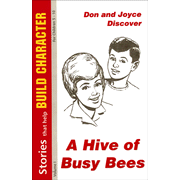
A Hive of Busy Bees: Stories That Help Build Character for Children 5-10  -     
        By: Effie Williams


- A Hive of Busy Bees, recommended by Jess. This Christian character-building book is beloved by all in this house. The first day it arrived, Daddy began reading it to the boys. The next morning Peter grabbed it upon waking, telling me he wanted to read it during the day. "This is a very interesting book, Mommy. Thank you for buying it for us." The brother and sister in the stories visit their grandparent's farm, so of course Peter, my farmer in training, delights in the themes. I'm charmed by the wholesomeness packed into every page. Now, both boys are reading it for pleasure during the day. I'll have to buy book 2 this week.


The quality of writing is mediocre; editing could be better and semicolons are rampant. I suspect the writer was new to the field when these were published. If I were to publish something at this stage of my craft, it too would be unpolished. It takes years of practice to write professionally. However, I still recommend these books! Click on Jess' link above to read her wonderful synopsis.


- My mother had a small cancerous breast lump removed at age 63. No problems for her since then; she is now 70. A cousin of mine will have a double mastectomy in early November, at age 50. The good news is that breastfeeding reduces your risk, with long-term breastfeeding providing the greatest protection. Women who have their first child after 30 are at an increased risk for breast cancer, but this is not true for older mothers who breastfeed. Keep up the nursing for as long as you can. Benefits below found here.


  1. Reduces the risk of breast cancer. Women who breastfeed reduce their risk of developing breast cancer by as much as 25 percent. The reduction in cancer risk comes in proportion to the cumulative lifetime duration of breastfeeding. That is, the more months or years a mother breastfeeds, the lower her risk of breast cancer.
  2. Reduces the risk of uterine and ovarian cancer. One of the reasons for the cancer-fighting effects of breastfeeding is that estrogen levels are lower during lactation. It is thought that the less estrogen available to stimulate the lining of the uterus and perhaps breast tissue also, the less the risk of these tissues becoming cancerous.
  3. Lessens osteoporosis. Non-breastfeeding women have a four times greater chance of developing osteoporosis than breastfeeding women and are more likely to suffer from hip fractures in the post-menopausal years.

Benefits for baby are numerous as well, including protection from several different types of cancer.

- Hearing Peter say this afternoon, "Isn't art the best thing ever, Mommy?"

- Yesterday we ventured to homeschool gym/fellowship time, only to find the church doors closed and locked and the parking lot empty. We were dumbfounded, since we never received any e-mails pertaining to a time or day change. Beth's appointments prevented us from going a couple times, so perhaps a change was given verbally to the participants? 

Anyhow, all were disappointed so we went to a park instead. For the hundredth time since becoming a parent, I marveled at God's design for the human face. Beth climbed up onto a slanted tree stump, only to fall head-first into the base of it. Though she was all scratched up and bleeding slightly, as I inspected the wounds, I marveled at the protection her eyes received; the worst of the scratches were a fraction of an inch from her eyes. God continues to amaze me, as I parent the very active, full-of-life blessings entrusted to me! 

Can I hear an Amen?

- No car repairs for the last two weeks. Amazing grace...how sweet it is

- The benefits from Peter's increased Strattera dose continue. My boys are closer than ever right now.

- Since writing to you about my last parental blow-up, I've been a good little girl. Amazing grace....how sweet it is.

- Although I had read this blog before, I rediscovered it recently, thanks to a link found on Kristen's We Are That Family blog. This Katie girl (only 23 years old) is amazing! Her main ministry blog is Amazima Ministries. The first link is for her personal blog. She adopted 14 Ugandan children and serves many others!

Monday, October 17, 2011

Children Are Natural Learners


It all started when Mary found a canvas binocular bag, complete with velcro closer and a shoulder strap. Her mind began working. What can I use this for?

Soon, she asked, "Mommy, can I be a newspaper deliverer when I grow up?"

After hearing my answer in the affirmative, she set about "designing" a newspaper to put into her bag.

Later I heard tears of frustration from very focused, very determined, almost-five-year-old Mary.

Unable to help--I'd already delayed my shower for other kid-related reasons--I enlisted Paul's help. "Please help Mary design a newspaper. She wants to make newspapers so she can deliver them."

Paul responded, reluctantly at first. Then his own mind began working.

Out of the shower, I found all four children designing newspapers. Thrilled, I commended them for including ads, since that was one way newspapers and magazines generate revenue.  Hearing that, they each cut ads out of a mail circular. Next, they glued them down and surrounded them with made-up headlines. (Miss Beth just practiced with her scissors. Thankfully, she doesn't get frustrated with how little she can do, compared to her siblings. She's just happy they welcome her).

"Fall is here!"

"New exhibits at the Cleveland Zoo!"

"Basketball this season will be in the house"

"Carriage and Wagon Rides 2 Cents"

"Free Help With AWANA Verses"

"Mr. Poller Comes Out of Hospital"

"Mr. Goodrich is 100 Years Old"

"A Parade is Coming on the 19th"

"Good Year Tire Factories Now Open!"

"Bulb Ads Coming March 2012"

"Bug Supply Ads Coming January 2012"

Newspapers were all the rage here for about an hour. I dutifully marked "writing" off both boys' daily school lists.

Later they asked, "Who marked my "writing" column?" (They usually do their own marking)

I responded. "I did."

"But I didn't do writing yet." 

I went to get their newspapers and showed them their "writing".

I love this about free time. My children often use it for learning-related schemes, never realizing it. 

In fact, the more I observe children, the more I realize that imagination unlocks so much of their potential.

The case against over-scheduling and teaching to the test has never been stronger in my mind. Children are natural learners

Serving them well, preparing them well for the future, means we must be primarily facilitators. 

- We must give them time to create.

- We must ensure that a variety of materials are always available (paper, glue, magazines, newspapers, paint, ink, markers, etc.), or allow them to innovate--even if it's messy. 

- We must encourage them by delighting in their work.

- We must use their creative works to evaluate their learning, and then target lessons to address weaknesses. 

They may demonstrate knowledge on a test right after studying, but if it doesn't transfer to their creative works, the concepts aren't quite mastered--they aren't second nature yet. Tests are one tool to evaluate learning, but the best way is to observe students create. What can they really do? Do they instinctively know where to go for information? Can they problem-solve? Can they innovate? Can they work with a partner--combining their strengths....supplementing their weaknesses?

Observing my kids and watching them grow, I'm so thankful for homeschooling. Only the one-room schoolhouse can duplicate, to some extent, what I can do in my home