Thursday, November 14, 2013

When You Feel Discouraged


Suppose I asked you to list three forms of suffering in your current life? Which trials would you deem the most serious? Can you even think of three, or are there far more?

I ponder this myself at a discouraging time. Trying not to sink into self-pity--which I consider a grave sin--I'm comparing my trials to my blessings, and guess which come out on top?

I started a daily dose of the antidepressant drug Elavil (25 mg) nearly two weeks ago to fight my migraines, and I've had a headache every day since, two of which caused me to miss appointments (speech for the kids, and helping in AWANA). I read such rave reviews about this drug's ability to fight migraines, that I never considered it might not work for me.

I know it sometimes takes time for a drug to be therapeutic, but still, I'm discouraged. Canceling things makes me feel like a failure; I don't like to let people down. They probably don't consider that it's the sin curse letting them down, and not me?

I have to wonder if it would be better to stay on the rebound headache pattern and just take a daily dose (or two) of Tylenol and caffeine. Surely those are better for the body than a daily antidepressant? Am I gaining anything by trying to fight this with prescription drugs, and adding side effects into the mix?

In the past I rejected the idea of prescription migraine drugs because I was either nursing a baby or pregnant (2001-2013). Suddenly, Tylenol and caffeine (1000 milligrams and 128 milligrams, respectively) don't seem so bad. In the past, fewer of my headaches landed me in bed, so I'm going backwards.

That's my story today, and I'm sure you have one too.

What can we cling to when life seems so hard? How do we fight discouragement?

Here's what I'm clinging to, and maybe you can add your own list in the comments?

1. Paul the Apostle tells me my troubles are momentary (and I believe him).

2 Corinthians 4:16-18 Therefore we do not lose heart. Though outwardly we are wasting away, yet inwardly we are being renewed day by day. For our light and momentary troubles are achieving for us an eternal glory that far outweighs them all. So we fix our eyes not on what is seen, but on what is unseen, since what is seen is temporary, but what is unseen is eternal.

2. I am not alone in my suffering.

We shouldn't be grateful that our troubles are less serious than the next person's. Should our gratitude really lie in comparing ourselves and deciding we come out on top in terms of suffering? Is that true gratitude...to be grateful I only have to take medicine, rather than living my whole life in a wheelchair? Or learning that I'm dying from cancer? If gratitude lies in comparisons, what does the dying cancer patient have to be grateful for, or the wheelchair patient, or the Indian girl sold into slavery?

Instead, I gain perspective by remembering that all humanity suffers. I'm not alone in feeling that life is very hard sometimes. It's very hard for all of us. The good news is that because Jesus became flesh, he can identify with our earthly suffering. We are never alone.

3. I can bring Glory to God through my suffering.

All people suffer, yes, but they don't all suffer well. With the power of the Holy Spirit, through prayer, I can manage my suffering well, to the glory of God. I can refuse to wallow in self-pity; I can count my blessings. I can focus on others, not on myself. In the midst of a headache, I can lay low and pray and pray and pray. Illness stops us in our tracks; sometimes we need a kick in the pants to embrace a life of prayer.

I mentioned that I feel like a failure when pain causes me to cancel things, but in truth, what really makes me a failure? I'm a failure when I live for myself, rather than for God. If God wants me to have headaches so I can better my prayer life, then He has my full blessing. I submit to your will, Lord.

4. Suffering gives birth to compassion.


2 Corinthians 1:3-5 Praise be to the God and Father of our Lord Jesus Christ, the Father of compassion and the God of all comfort, who comforts us in all our troubles, so that we can comfort those in any trouble with the comfort we ourselves receive from God. For just as we share abundantly in the sufferings of Christ, so also our comfort abounds through Christ.

Whenever I come across someone who suffers chronic pain, my heart aches for them in ways it never would had migraine never entered my life. I think of them and pray for them often, and this in itself is gift. It takes my focus off of me, which is victory.

5. Suffering tests my faith.

John Piper on suffering: "All experiences of suffering in the path of Christian obedience, whether from persecution or sickness or accident, have this in common: they all threaten our faith in the goodness of God and tempt us to leave the path of obedience. Therefore, every triumph of faith and all perseverance in obedience are testimonies to the goodness of God and the preciousness of Christ -- whether the enemy is sickness, Satan, sin or sabotage.

Therefore all suffering, of every kind, that we endure in the path of our Christian calling is a suffering "with Christ" and "for Christ." With him in the sense that the suffering comes to us as we are walking with him by faith, and in the sense that it is endured in the strength that he supplies through his sympathizing high-priestly ministry (Hebrews 4:15). For him in the sense that the suffering tests and proves our allegiance to his goodness and power, and in the sense that it reveals his worth as an all-sufficient compensation and prize."

Yes, I have headaches. But I also have...

...a Heavenly Father who loves me with a wild and beautiful grace.

...the Holy Spirit as a down payment on my eternal inheritance.

...a new heart in Christ.

...victory over my sin nature.

...eyes that spiritually see.

...everyday graces in my children and my husband.

...fellow believers to share my burdens with (that's you, friends, and thank you!).

...the Bible as the living Word of God.

...the ability to truly love, through Him.

...forgiveness.

...His faithfulness.

...His power.

...His Truth.

Dear friends, how rich we are! Hallelujah.

Monday, November 11, 2013

Making Peace With Your Problematic Child, Part 2


As we resume our talk about difficult children, I want to begin with a few preventative measures that help keep meltdowns and horrid days at bay.

Establish Routine:

All children benefit from a daily routine, but with high-needs children this is especially important. They're less able to adjust to change, so once they realize we've mixed things up, their stress levels elevate and poor behavior emerges. Think of it this way: When a child's internal regulators are faulty or immature, causing the child to act impulsively, a routine, predictable environment functions as a substitute regulator. When we mess with their substitute regulator, they're lost and frustrated.

I'm the first to admit that it's hard to get up every day and do the same things in the same order, but this is what most kids need to feel secure.

For example, if I'm behind on bill paying and I'm forced to sit down in the morning and get paperwork ready for mailing, my children will notice the change of routine, and sure enough, within twenty minutes I'll see behavior problems.

Routine is comforting to kids, not boring, but most of them can't articulate or understand this. When they get cranky, they don't always know why.

When I was teaching first grade the worst behavior I saw came on specialty days (field trips, awards-assembly days, field days, and during holiday celebrations). It's wonderful to give kids something to look forward to, but be ready for a more taxing day and try to prepare them ahead of time for the altered schedule.

Relaxation:

High-needs kids also need more time to relax--a segment of their day they can use as they wish, with no demands placed on them. They can't handle as much errand-running or as many extra-curricular activities. It's temping to think that if we keep kids busy enough, they'll stay out of trouble. But how do we feel when every minute of our day is filled? Cranky, right?

Johnny may swear up and down that he wants to play soccer this season, but does he really understand what the new schedule will look and feel like? Can he predict that it's going to make everything feel rushed (homework, dinner, bedtime...everything)?

It helps to remember that unlike us, children have little control over their schedules and that in itself can be difficult, especially for strong-willed children. Give them a segment of time each day to call their own, and if they need assistance coming up with free time ideas, you can help them brainstorm a list of available options, emphasizing that the goal is to relax.

Positive Feedback--Running Journal Conversations:

I mentioned last time that I wanted to discuss ways to counteract negativity in daily interactions. One way to do this is to keep a running journal conversation going with your child. Sit down at night after all are in bed, and write a letter to your child, recording what he did that impressed you or made you feel proud. Tell her how much you love her, and how blessed you are to be her mom. Also, if your child is old enough to write back, respond to the last entry he wrote in the journal, and try including key Bible verses that will help your child feel the depth of God's love for him.

This is a time to say all those lovely things you were too stressed to say during the day. They really need to be said and a journal is perfect for this. When they're in trouble frequently during the day, the positives get lost in the fray while mom or dad are trying to recover emotionally and mentally from frequent altercations.

Often, the more we get upset, the less they feel loved, and the more unloved they feel, the more they misbehave, even if they can't articulate exactly why. It's a vicious circle that must be broken by an explosion of positive feedback.

Positive Feedback--Fill Their Emotional Cups:

Carve out a few minutes during the day to fill up their emotional cups, starting in the morning. Some kids might enjoy a hug and a loving morning greeting, others a story, others a cup of cocoa and some conversation. The more children you have, the harder this is to fit in, but it really does work.

When our husbands, for example, take the time to fill our emotional cups, doesn't it set the tone for a lovely morning? We all need this.

Positive Feedback--Stop comparing:

It goes without saying that kids don't appreciate being compared negatively with their siblings or peers. Deal with the issue at hand without bringing in hurtful comparisons. When we blow this, we need to offer an apology quickly.

For one thing, when we compare, children get the impression that they're the cause of all the trouble in our lives--as though without them, life would be peachy. What a way to empty their emotional cups and invite more trouble!

Positive Feedback--Daily Impromptu Prayer Sessions:

Sit down with your child as soon as you feel the stress level rising between you. Hold hands and pray together, asking God to intervene in your relationship. Your child will appreciate that you care enough to ask God for help, and she will learn that God is your strength and your song, and that this same close God-relationship is available for her too.

Positive Feedback--Finish Strong:

If your child's a handful at bedtime, this one is especially hard, but try to finish the day strong in the Lord. Even if the last minutes are strife-filled, take a few minutes to calm down, and then walk back into their bedroom and kneel and pray together. Humbling ourselves before God in this way, hearts as one, reminds us that we're in this together, and even though Satan is trying hard to bring us down, we will still triumph if we lock hands and hearts with the Father.

Something to take with you....It takes a lot of positive feedback to counteract everyday mistakes made while parenting high-needs, high-maintenance children. We have to take responsibility before God for our parenting mistakes, and ask Him to direct our path as we work to accentuate the positive and leave negative relationship patterns behind.

Very often, when there's a difficult child in the home, there are also broken relationship patterns that need fixing. We are not the cause of our child's difficult issues or difficult personality, but we can certainly be part of the problem.

Prayer and humility go a long way. Praise God that we serve a gracious Father who's always willing to give us a fresh start.

To recap:

~ Establish Routine
~ Ensure Relaxation
~ Have Journal Conversations
~ Fill Their Emotional Cups
~ Stop Comparing
~ Impromptu Prayer Sessions When Stress Levels Rise
~ Finish Strong in the Lord

What works in your home? Do you have a high-needs child?


Friday, November 8, 2013

Homeschool and Mother's Journal Nov 8


In my life this week…

This week I'm preparing for a dinner party, which is a brave undertaking for me. Normally I have only one or two people over at a time, but this time two sets of aunts and uncles are coming, and possibly a single friend.

My dad's mom and my mom's mom were placed in the same nursing home in Ohio years ago, and miraculously, they ended up in the same room.  My family lived in CA at that time, where I was going to college.

Thrown together often due to frequent nursing home visits, were my dad's sister and my mom's sister. These two aunts became friends and have remained close for the past twenty-two years, and it's these ladies and their husbands who will grace our home this Saturday. We don't see them often, although they live quite close; one had 6 children and the other had 4, so their families and grandkids keep them plenty busy.

Of all the things I could make to feed 11 people--with most of the work done ahead of time--I decided on a soup and salad and bread bar. Thus, I have four soups to prepare, two different kinds of breads, and a large salad with side fixings, plus a chocolate cake to prepare. One aunt is also bringing a dessert.

I decided on these soups:

potato soup with bacon
sausage tortellini soup
navy bean with ham
taco soup (with milder Rotel this time around)

And these breads:

honey corn bread
pumpkin bread
whole wheat french bread

And then of course, there's the house and the four kids to wrangle with as well, which is why I don't often entertain on larger scales.

Paul will play 3 songs on the piano for entertainment, and the girls and Peter will recite Bible verses they've learned in AWANA, and possibly a silly Thanksgiving turkey song. Only one of my aunts is Christian--only four Christians exist in my entire clan, both sides included--but I decided that leaving out the verses for the sake of the non-Christian aunt and uncle would be as though I'm ashamed of the Gospel.

At any rate, I'm praying for hearts to receive His truth.

My 90-year-old father-in-law is still in the rehab center in Florida. They keep pushing back his release date for various reasons. He wants to go back to his Florida home, living alone with part-time hired help, but that is not what doctors recommend for him. He already had a second fall, this time in the rehab center bathroom. He can't stand hands-free without losing his balance, so they have an alarm and device on his bed to prevent him from getting up without help.

We call him several times a week, and those conversations can be stressful because he's just so stubborn, though I understand him feeling like a prisoner. He doesn't want to live with us, or in an assisted living facility near us. His decision puts pressure on his neighbors, which bothers us because it should be family shouldering any burden of his care, not neighbors.

But, we can't force him and the assisted-living facilities charge an average of $3500 a month, which is not covered by medicare (only nursing homes are). He has enough money but feels sick about giving it to these facilities, which provide only mediocre care at best, due to hiring low-wage workers with high turn-around.

We have much to pray about and we have to cling to the Father in hope. We want my father-in-law's last years to be full of dignity, and yet we can't move down there for various reasons. His house is a tiny one-bedroom with bonus sunroom, for one thing.

In our homeschool this week…

The boys have added Sadako and the Thousand Paper Cranes by Eleanor Coerr, as we hang out in Japan this week. I cried and cried at this story and I feel for the boys as they near the ending. It's yet another reminder that war is devastating and ugly and should never be taken lightly. As we read the news about various wars, it's far different than delving into the story of one person affected by the events.

Personal stories help children learn the most facts and uncover all the layers of a topic, more effectively than non-fiction at some levels, and I'm glad Sonlight includes both for our enrichment.

Sadako and the Thousand Paper Cranes

Scholastic Synopsis: Two-year-old Sadako Sasaki was living in Hiroshima when the atom bomb was dropped. Sadly, ten years later, she was diagnosed with leukemia, also known as "atom bomb disease."

There is a Japanese legend that says that if a sick person folds 1,000 paper cranes, the gods will make her well again. Sadako spent long hours in bed, folding those paper cranes, and never giving up that hope. When Sadako had folded six hundred and forty-four cranes, and they hung above her bed on strings, her classmates folded the rest.

Today there is a memorial in Hiroshima Peace Park dedicated to Sadako. Children come there and leave the paper cranes they make in her honor.

Sadako and the Thousand Paper Cranes is based on a true story.

As my children delve into Sonlight's Eastern Hemisphere package, they're learning about other religions (and cultures) with the purpose of praying for the lost and better understanding the depth of their confusion and deception. Most of the nations they're learning about are in the 10/40 missionary window--the largest concentration of unreached people groups of the world.

The purpose is not to accept that every nation has its own religion and that's okay. Instead, they're learning that we can show respect for all people while still praying they'll come to know Truth. Buddhism is the most difficult, so far, and it does bother Peter's OCD to read about it, but we're getting through it.

Islam, Judaism and Christianity are similar in that they share some Bible scripture beginnings, with the first two departing from Christianity at some point in the Old Testament.

Other School News: After lunch each day we read a Thanksgiving book, and then make a construction paper leaf, writing on it what we're thankful for that day. We then tape it on a Thanksgiving Tree my Paul designed on white butcher paper. You could make this quite elaborate, but we're simple here most of the time.


The children and I are really enjoying this, and wanted to recommend some Thanksgiving books for you. I've always loved teaching the Thanksgiving story, and I admit to owning all of these books and more over the years.


The Thanksgiving Story

The Thanksgiving Story, by Alice Dalgliesh

Publisher Synopsis: Dagliesh and Sewell received praise for the clarity and immediacy of their picture book, a hit of the season in 1954. Today's children, beginners and advanced readers, will value the story about one family's first Thanksgiving in the Plymouth Colony, strikingly present in stylized, naive pictures like colored etchings. Giles, Constance and Damaris Hopkins are aboard the Mayflower, overcrowded when the Speedwell turns back to England. On the journey, the children's baby brother is born and named Oceanus; he will be one of the smallest in the company of settlers who endure the terrible first year in the New World and gather to celebrate the harvest the next November. The story ends with the great feast to which the colonists invited the Indian chief Massasoit, Squanto and their people who had helped the strangers survive hunger, cold and sickness.

N.C. Wyeth's Pilgrims

N. C. Wyeth's Pilgrims, text by Robert San Souci

Publisher Synopsis: The adventurous saga of the settling of the Plymouth Colony is strikingly portrayed in this magnificent book. Spectacular paintings by renowned artist N.C. Wyeth, gloriously bring to life the carefully researched text by well known children's book author Robert San Souci. The story of the Pilgrims, including the first Thanksgiving, is a central part of America's history and, over the course of time, it has taken on an almost mythical quality. Drawing upon a variety of resources, including the author's trip to the Plimouth Plantation, the text dispels some popular misconceptions about the setting of our nation as it broadens our understanding of the bravery and determination of our forebears. A beautiful artbook as well as an informative history book, N.C Wyeth's Pilgrims belongs in every home, library, and classroom.
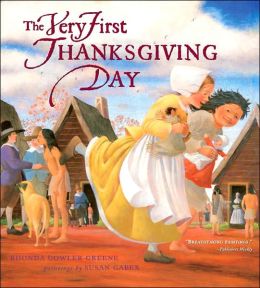
Very First Thanksgiving Day

The Very First Thanksgiving Day, by Rhonda Gowler Greene

Publisher Synopsis: The story of the first Thanksgiving celebration, told in cumulative rhyme, introduces young readers to America's most beloved national tradition, which began with a shared feast to rejoice in the bounty of the land, new beginnings, and peace between two societies.
Exquisite paintings by Susan Gaber transport the reader back to the earliest days of American history with meticulous detail and breathtaking imagery. Sure to be a yearly favorite, The Very First Thanksgiving Day will resonate with readers young and old on this day for thanks and blessings.

Samuel Eaton's Day: A Day in the Life of a Pilgrim Boy

Samuel Easton's Day: A Day in the Life of a Pilgrim Boy, by Kate Waters

Publisher Synopsis: Samuel Eaton is a young boy living in an early American settlement in the year 1627, and today is the day he will help with his first rye harvest! If he can prove to his father he's up to the task, he will be able to help with all of the harvest. But harvesting rye is even more difficult than he expected. Was he foolish to think he could do a man's work?

Text and photographs follow a six-year-old Pilgrim boy through a busy day during the spring harvest in 1627: doing chores, getting to know his Wampanoag Indian neighbors, and spending time with his family.

Sarah Morton's Day: A Day in the Life of a Pilgrim Girl (Scholastic Bookshelf Series)

Sarah Morton's Day: A Day in the Life of a Pilgrim Girl, by Kate Waters

Publisher Synopsis: At sunup when the cockerel crows, young Sarah Morton's day begins. Come and join her as she goes about her work and play in an early American settlement in the year 1627.
There's a fire to build, breakfast to cook, chickens to feed, goats to milk, and letters and scripture to learn. Between the chores, there is her best friend, Elizabeth, with whom she shares her hopes and dreams. But Sarah is worried about her new stepfather. Will she ever earn his love and learn to call him father?


The First Thanksgiving

The First Thanksgiving, by Garnet Jackson

Publisher Synopsis: When the Pilgrims landed in New England, many died during the first harsh winter. This easy-to-read story describes the first Thanksgiving celebration and tells how Native Americans helped the Pilgrims through that first difficult year.

Pilgrim's First Thanksgiving

The Pilgrim's First Thanksgiving, by Ann McGovern

Publisher Synopsis: Elroy Freem (the pseudonym of a popular children's book artist) gives this reissue of a favorite story new life. Teachers, parents, and children will give thanks for this easy-to-read, larger format book with lively, full-color illustrations.

This particular book is full of rich details; I feel the above synopsis doesn't do it justice.

The First Thanksgiving

The First Thanksgiving, by Linda Hayward

Publisher Synopsis: Young readers start the familiar story behind our tradition of Thanksgiving Day in England in 1620, when the Pilgrims are setting sail for far-off America, leaving behind friends and safe homes. The reasons for their journey, the trials they endure while at sea, and all of their amazing adventures are detailed in this easy-to-read book.                                                                                                                                    

On the Mayflower

On the Mayflower: Voyage of the Ship's Apprentice & a Passenger Girl, by Kate Waters

School Library Journal Synopsis: Photographed on the Mayflower II, a replica of the original ship, this fourth book in an acclaimed series charts the high seas friendship of two young passengers. "Well written, designed, and photographed." — School Library Journal

Helpful homeschooling tips or advice to share…

When I can't think of a specific tip, I like to just say...pray, pray, pray. It's the single best course of action for any homeschooling mother. It ensures that God's will is alive in our homeschool.

Places we’re going and people we’re seeing…

We went to Beth's three-month rheumatology check, and thankfully, they aren't increasing any of her medicines, though her swelling is up. They told me they expect arthritis flares after any surgery (she had her tonsils out last July). She is getting around pretty well and not complaining of pain, so I am very, very, thankful.

We don't go a lot of places or sign up for a lot of events, because the minute we prepare for an outing and leave the house, we lose academic time. As most of you well know, it's hard to get back in the groove with school after an outing. We choose very carefully how we'll spend our time, making sure the children have far more down time than running around time. Every family is different, but we're happy in our home together. The kids generally hate driving around unless it's for a seasonal field trip.

My favorite thing this week was…

Mary, age 6, made up a worship song stanza, which delighted me. I've also enjoyed every Thanksgiving reading segment this week.

And every time I sit down with my children individually to study AWANA verses, I'm so blessed. We sit in a rocker together and make it a special cuddling time.

My kiddos favorite thing this week was…

They love company, so I can tell you ahead of time they'll say having a dinner party was their favorite.

Things I’m working on…

I'm losing the migraine battle, so I began again taking the Elavil I wrote about a few weeks ago (a daily preventative medicine). I'm working on getting over the grief that this is even necessary, and trying to be patient as my body gets used to the medicine.

I’m cooking…

crockpot black bean soup
whole baked chicken
homemade chicken noodle soup
shepherd's pie
sausage marinara spaghetti
tortellini soup
potato soup
crockpot navy bean soup
taco soup

I’m grateful for…

~ a Compassion letter from Burkina Faso

~ a warm home for these cold November days (first real snow on its way, I'm told)

~ a husband who listens

~ sweet kids growing in the Lord

~ grace for the hard days

~ children who forgive each other

~ a huge leaf pile (Peter's hard work, mostly)

~ Peter offering to rake and gather the neighbor's leaves, and doing a good, thorough job. They didn't say thank you (he told them it was for his leaf compost), but I praised him for his hard work and diligence.

~ pumpkin smells in the kitchen

~ looking forward to fellowship with aunts and uncles

A quote to share...

Proverbs 16:3
Commit to the LORD whatever you do, and your plans will
succeed.

Thank you for reading. Have a wonderful day!

HMJ Logo 500x484


 top image

Thursday, November 7, 2013

Mary Writes a Song


Busy hanging clothes the other day, I was graced with Mary's presence, her face all a glow.

"Mommy, I wrote a song in my head and I need you to write it down." 

Mary's Best Song

Oh, Lord, I need you.
You take me up.
You clear my heart from sin,
You make me new again

Hopefully there will be another stanza soon!

Tuesday, November 5, 2013

Making Peace With Your Problematic Child, Part 1


When I brought my Peter home from the hospital all those years ago, I never dreamed he'd be so hard to raise, or that he'd bring out the worst in me. To me, he was a miracle: an angel baby born fourteen months after the 21-week gestational loss of our son Isaac.

I had been through the most difficult year and a half of my life, further complicated by preterm labor: dilating two inches at 30 weeks gestation, with nearly constant small-scale contractions. They gave me brethine--a preterm labor drug--but it wasn't very effective.

I was on bedrest for 8 weeks, after which my water broke at 37.5 weeks gestation. Labor was routine, but with lots of howling pain because the bedrest started before any Lamaze classes, and the epidural was given too late (story of my labor life, but with my last baby, I learned to breathe!).

I had no idea what I was doing, despite lying there on bedrest for weeks, reading pregnancy magazines. The nurse kept telling me to breathe but I just couldn't manage it.

Pushing lasted two hours, after which forceps were used to help deliver my baby. After it all, Peter was born in good condition, thankfully.

But it wasn't smooth sailing.

I developed preeclampsia shortly after he was born, landing me back in the hospital while he stayed at home with Daddy for five heartbreaking days (or was it four...I can't remember now.) While Daddy dealt with jaundice at home, and the associated daily pediatrician checks, I worked on my breast milk supply while begging God to heal me, and the jaundice.

I pumped breast milk but was told to "pump and dump" because of the magnesium sulfate drug preeclampsia patients are forced to take. One nurse thought the drug wouldn't hurt my baby, having recently been to a seminar where she learned that all drugs are okay--excreted so minutely into breast milk anyway--except for street drugs and cancer drugs.

The pediatrician, however, was adamant: pump and dump. So Peter was given formula in a bottle for the five days I was in the hospital, and once home, I pumped my milk for him until he learned to latch at three weeks old. It was rough going, but after five weeks old, he never took another bottle.

He was fussy from three weeks to five months old, like all my children. I had a rapid let-down reflex in one breast, as well as general over-supply problems. After five months old, they were champs at keeping up with the milk, but still, there were frequent clogged ducts no matter what I did.

Peter spit up copiously about three times after every feeding, for an entire year, and his tear ducts took a year to open, resulting in the green eye junk you see in these babies. Despite cleaning his eyes frequently, I dealt with some nosey comments, such as:  "I think your baby has conjunctivitis; shouldn't you take him to the doctor?"

He also was born with a hydrocele in his scrotum, which required surgery at two years old.

All this to say...parenting didn't come easy for me from the start. It was a delight and I was on cloud nine, don't get me wrong, but those were grueling times.

I wish I could say things settled down, but from an early age, Peter was high-strung and extremely active, walking at just under nine months old, and rarely stopping for a cuddle. He was smart and fun, but by 3.5 years old, he was the main source of stress in my life, and that remains true today.

He has trouble controlling his emotions, reaches a frustration threshold far sooner than most of us, talks incessantly and loudly, unless he's reading, and hyperfocuses something fierce. Once he becomes interested in something, he lives and breathes it, follows you around and talks and asks about it almost non-stop, unless he's reading.

In case you hadn't guessed....yes, it's a blessing this child likes to read.

He has trouble waiting his turn, and our most recent stress was caused by his brother's birthday. Every year when a birthday comes, Peter pressures the sibling into getting what he wants...not what they want. It's an incessant thing, and as a result, holidays and birthdays are extra stressful for everybody, despite discipline techniques employed faithfully. ADHD kids just have terrible control over their impulses, and act like they are perpetually three years old, when it comes to waiting for something. (My son has the hyperactive/impulsive type of ADHD, not the predominately inattentive type).

They also can't control their movement impulses, so hyperactivity is always an unwelcome visitor, no matter how much regular exercise you encourage.

When these kids want something, they go after it full force, even if they realize cognitively that they're driving you insane. They feel guilty, yes, but they have so little control over the impulse, that they can't stop fixating on the desired thing, whether it's a trip somewhere, a keen interest (animals, nature, etc.), a food item, or what have you.

They can be so relentless, hate can creep into your heart sometimes. Oh, not real hate, but a dislike so strong during their relentless onslaughts, that all you want to do is get in the car and drive far away, because there are no answers to this disorder and rarely a break. It isn't something that gets better, and medication helps in only minor ways.

The result is that the child grows to hate himself, and the whole family grows to hate what this child does to the collective peace. In fact, when the child is gone for some reason, the family dynamics are amazingly different. It's bittersweet to love a child so much, and yet barely be able to tolerate them so often.

It's not surprising that these kids grow up with a lot of negative interaction. Their self-esteem suffers because they're always in trouble, people are frequently angry at them, and for much of a typical day, they feel like failures.

There are good things, of course: they tend to be intelligent, fun, and imaginative, but they're so high maintenance that the positives get lost in the fray.

How do you survive your difficult child, keeping your own health intact, while assuring that they feel the full weight of your motherly love? Telling them how deeply they're loved isn't very convincing when 75% of the interaction is negative on a daily basis.

Statistically, these kids go to jail more frequently, take drugs more often, have problematic relationships, and end up depressed. Moreover, 65% of them have comorbid disorders, such as Bipolar Disorder, OCD, autism, generalized anxiety disorder, clinical depression, Tourette's Syndrome, oppositional defiance disorder, conduct disorder, and various processing disorders (learning disabilities).

Of these, my son has OCD, generalized anxiety disorder, Tourette's Syndrome (a tic disorder), and his dysgraphia--difficulty with handwriting, spelling, and organizing thoughts on paper--is a processing disorder.

He's one tough kid to raise, but I'm insanely in love with him.

Next time, we'll talk about how to counteract all the negativity, and how to forgive yourself for not being the parent you wanted to be.

It's not your fault, my friend. This is one fallen world.

image